


Optimize NVR performance with video surveillance hard drives
Rainer W. Why?, senior director of HDD business development Toshiba Electronics Europe, explains the tests carried out to show how the range of hard drives from this manufacturer meets the compatibility and performance requirements in a video recorder environment.
Los video surveillance systems and control are the backbone of modern security and guarantee the protection of facilities 24/7. It's natural, therefore, that engineers who work with network video recorders (NVR) be very aware of the importance of your reliability and efficiency.
It should be noted, first of all, the importance of compatibility and performance, since the function of an NVR in a video surveillance system is to manage and record video transmissions from IP cameras. Concretely, In the case of applications that use artificial intelligence technology (IA), like facial recognition, It is imperative that the NVR and its storage media work in harmony.
To evaluate its compatibility and performance within an NVR environment, los Toshiba video surveillance hard drives, including the series MG, S300 y S300 Pro, have been tested in a typical video surveillance scenario.
Methodology and configuration
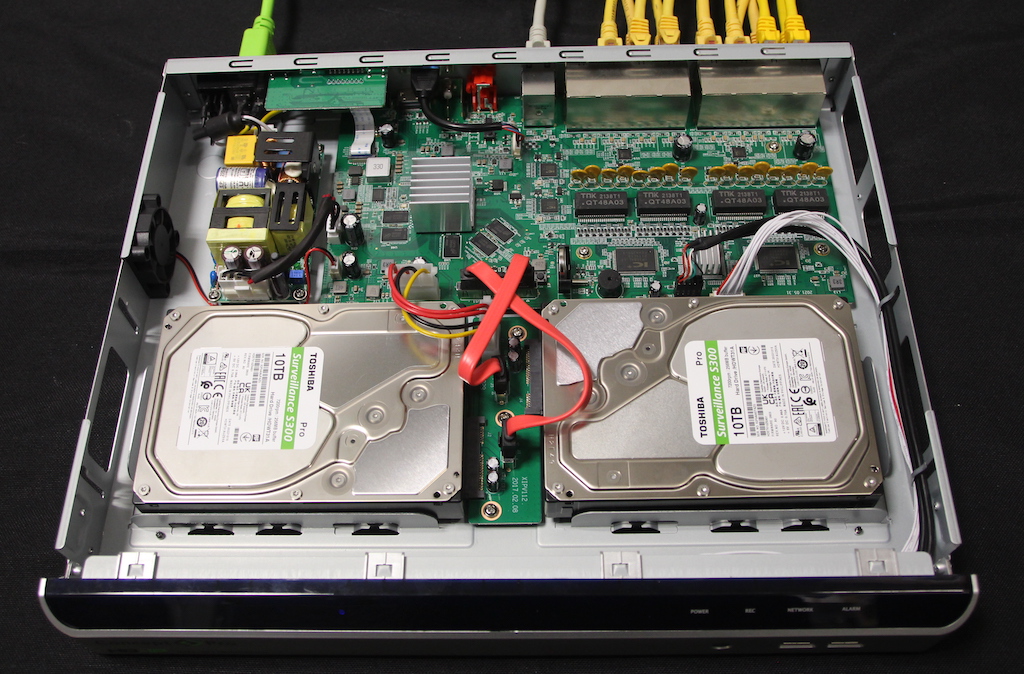
For this evaluation the NVR was chosen Concept Pro VUHDIP-16-3 of sixteen channels, what counts with two hard drive bays. In the test, two HDDs were installed working as one combined video storage system.
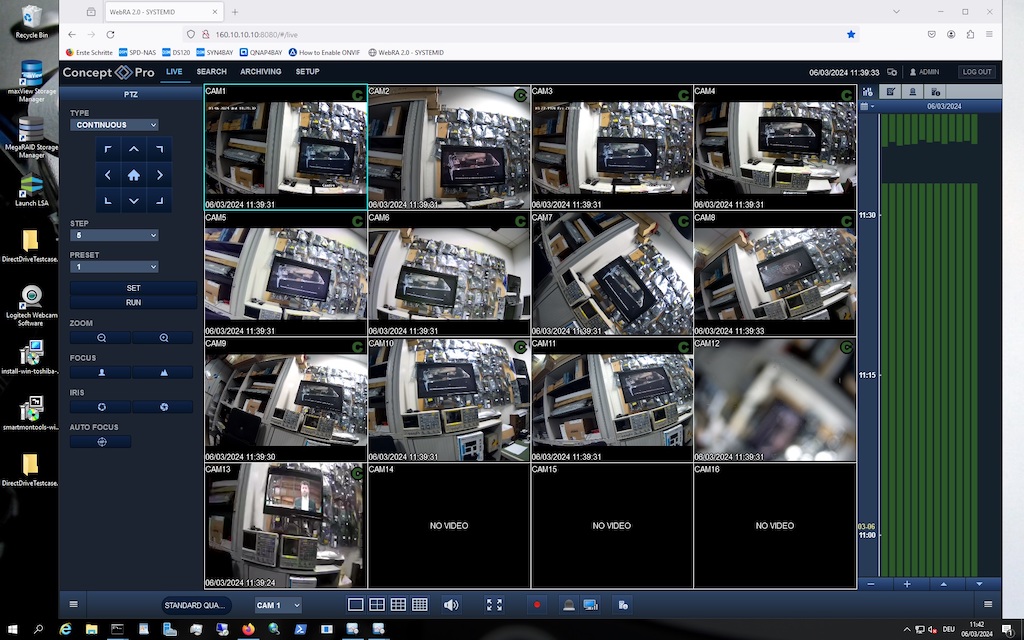
The configuration included thirteen network cameras with PoE power of different types that recorded continuously with full motion, emulating a common scenario in large residences, SMEs and home offices (top image).
The evaluation covered recording and playback with search functionality, total retention time, overwrite capabilities (for some disc models), total drive power consumption and hard drive operating temperature.
HDD models and testing conditions
Different Toshiba HDD models were tested in the evaluation, including basic series S300 (1TB, 2TB); the unit S300 Pro (4TB, 10TB), and a business model MG (18TB) for extended retention time. Thirteen PoE cameras were connected, recording full movement 24×7.
Besides, Test conditions were set to reflect real-world usage, with smart storage compression disabled and continuous recording. For access using the remote client (via web), NVR performance was optimized by setting frames per second (FPS) network streaming by camera by clicking on the settings icons, recording.
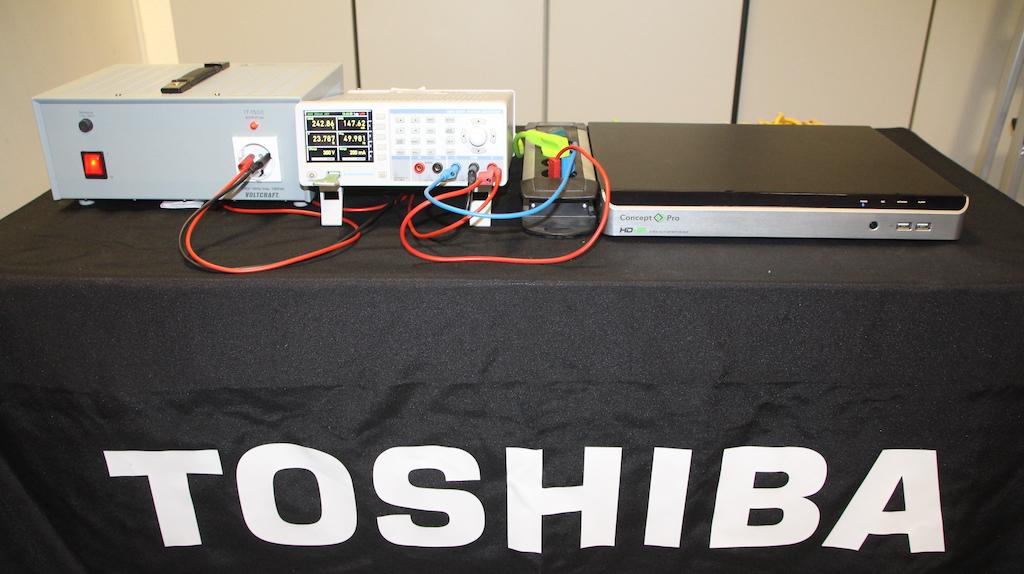
With a room temperature maintained at 26°C, HDD temperatures were monitored using the SMART parameter (self-monitoring, analysis and reporting technology) in the NVR GUI. With a high-precision professional energy analyzer Rhode & Schwartz energy consumption was accurately measured (second image).
Results and recommendations
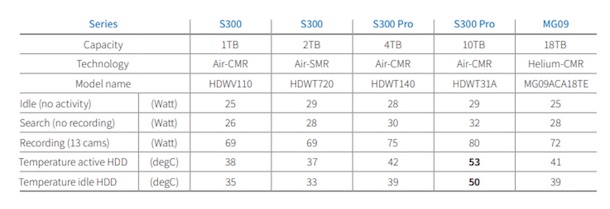
The tests confirmed that Concept Pro VUHDIP-16-3 is compatible with all tested Toshiba HDD models. It was also demonstrated a efficient energy consumption, which stood between 25W and 30W in idle mode, and at 70W and 80W during recording.
Las operating temperatures, from a functional point of view, remained within acceptable limits: 70°C (S300/S300 Pro) y 60C° (MG09). However, It was observed that average temperatures above 45°C could affect the long-term reliability of hard drives.
Taking these data into account, and although the result of using 4/6/8TB S300 Pro units is optimal, 10TB model should be avoided. For high retention and storage demands, Toshiba 12TB enterprise models are recommended (MG07ACA12TE) onwards (14TB: MG07ACA14TE; 16TB: MG08ACA16TE, 18TB: MG09ACA18TE, 20TB: MG10ACA20TE, 22TB: MG10AFA22TE).
The technical reason for this recommendation is that Toshiba hard drives up to 10TB (both business and S300/S300 Pro models) they are full of air. Hard drives that have lower capacities use fewer platters, while the 10TB model of S300 Pro employs a seven-plate stack that, spinning in air, require a lot of energy, which results in high consumption and heating of the device.
From 12TB, Toshiba enterprise hard drives are filled with helium, a light, homogeneous gas that, compared to air, Helps reduce flutter of thinner dishes. As a result, More thin platters can fit in the hard drive casing and higher capacities are achieved.. Besides, helium gas, being thinner than air, reduces friction and significantly minimizes the energy required to rotate the stack of plates.
The temperature results of the drives with 10TB air and 18TB helium can be seen in the attached table.
Performance and retention times
Testing confirmed overwrite performance on S300 1TB and 2TB models, as well as on and S300 Pro 10TB. Video retention times for the thirteen continuous motion IP cameras were, approximately, five days in 2x2TB configurations and around thirty days for 2x 10TB configurations.
It was also tested conventional magnetic recording technology (CMR) and that of staggered magnetic recording (SMR) and both worked well. In the first, tracks are written with a space between them, while with SMR they overlap, leaving a smaller surface area for the reading head. This means that more tracks can be written in the same area, which increases storage capacity.
It was also shown that, for NVR recording applications, the perceived disadvantage of not being able to randomly overwrite smaller blocks when using SMR technology is irrelevant.
Toshiba's wide range of video surveillance hard drives, from S300 series to MG business series, Proven to be highly compatible and effective with the Concept Pro VUHDIP-16-3 NVR.
These hard drives are suitable for various security applications and offer reliable recording capabilities, playback and search. Besides, Recorded data is accessed smoothly and power consumption and heat dissipation are low.
Rainer W. Why?
Senior Director of HDD Business Development Toshiba Electronics Europe

¿Te gustó este artículo?
Subscribe to our NEWSLETTER and you won't miss anything.