


AI video surveillance: the challenge of managing different workloads in storage
On this platform, Eun-Kyung Hong, Product Manager de HDD en Toshiba Electronics Europe, analiza la interrelación entre IA, almacenamiento y videovigilancia, un terreno con grandes oportunidades que ya están siendo exploradas.
La incorporación de la artificial intelligence (IA) a los sistemas de videovigilancia está transformando las exigencias del almacenamiento. A la continuous recording de imágenes se suman ahora procesos de análisis automatizado y gestión de metadatos que deben ejecutarse simultáneamente, pero que presentan patrones de acceso a los datos muy diferentes.
La convivencia de distintas funciones en la videovigilancia con IA plantea nuevos desafíos para las hard drives (HDD), que deben gestionar distintas cargas de trabajo sin comprometer la continuidad de la grabación. In this context, aspectos como la gestión de la memoria caché, The classification of requests and the planning of operations acquire increasing importance.
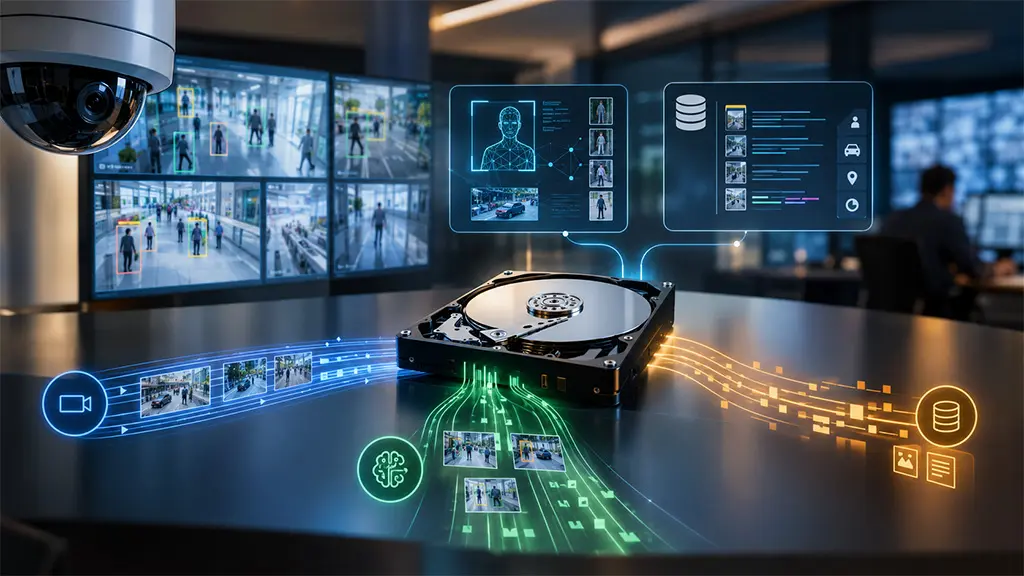
In a video surveillance system with AI capabilities, each activity generates a specific type of storage traffic, that is to say, different workloads on the same infrastructure. While continuous recording incorporates new video streams into the unit, analysis processes retrieve previously stored images to identify events or extract information. Simultaneously, the systems update the metadata associated with those images to facilitate their classification, indexing and subsequent retrieval.
La convivencia de distintas funciones en la videovigilancia con IA plantea nuevos desafíos para las hard drives (HDD), que deben gestionar distintas cargas de trabajo sin comprometer la continuidad de la grabación.
Although these operations develop simultaneously, their storage access needs are different. Video recording is mainly based on Long and predictable sequential writes, Which allow a constant flow of data to be maintained. On the contrary, Analysis through AI can generate multiple Random reads To access specific fragments of previously recorded images. Added to this are the small read and write operations related to metadata updating.
The combination of these patterns introduces new demands for the architecture and resource management of the HDD.
Behavior of sequential and random access
Hard disk drives offer a Sustained performance Especially suitable for sequential write operations. When data is stored consecutively, los cabezales de lectura y escritura necesitan realizar menos desplazamientos, lo que favorece la continuidad del proceso. Esta característica resulta especialmente relevante en videovigilancia, donde las cámaras generan flujos constantes de información que deben registrarse sin interrupciones.
For your part, las operaciones de lectura aleatoria presentan un comportamiento diferente. Para recuperar información ubicada en distintas posiciones del disco, los cabezales deben desplazarse repetidamente, lo que incrementa los tiempos de acceso y puede interferir con las operaciones de escritura que se están ejecutando simultáneamente.
Ninguno de estos patrones es intrínsecamente mejor que el otro. Ambos responden a necesidades concretas del sistema y el desafío surge cuando deben compartir los recursos de una misma unidad.
The importance of establishing priorities
Not all storage requests have the same time requirements. A request to retrieve historical images may coincide with real-time video recording, but a delay in each of these operations can have different consequences.
Storage management must consider not only the volume of data or the transfer speed, but also the nature and priority of each operation.
So, in certain analysis tasks, a small delay in accessing previously recorded images may be acceptable. Instead, a interruption of recording can cause the loss of information that will not be possible to recover later. For this reason, Storage management must consider not only the volume of data or the transfer speed, but also the nature and priority of each operation.
The ability to differentiate between requests that require immediate attention and those that can tolerate some waiting time thus becomes a relevant element for maintaining system stability.
Request classification and cache management
To respond to these needs, he firmware storage units can incorporate mechanisms for identifying and classifying different workloads. The goal is to distinguish between continuous write operations, read requests associated with image analysis and metadata updates, so that each one can be managed according to its characteristics.
Metadata updates introduce additional read and write operations that must also be coordinated with the rest of the activities.
Once identified, it is possible to adapt the use of cache memory and command scheduling to the different access patterns. While continuous recording benefits from management that favors the stability of the write flow, analysis operations require accessing small amounts of information distributed in different locations on the disk. Y, for his part, Metadata updates introduce additional read and write operations that must also be coordinated with the rest of the activities.
The organization of these resources seeks reduce interference between processes and facilitate the coexistence of workloads with different requirements.
Operations scheduling as a performance factor
In addition to cache management, the order in which requests are handled plays an important role. He command scheduler determines when pending operations are executed and how available resources are distributed among different activities.
In video surveillance environments, where the continuity of recording is a priority, this scheduling must take into account the timing requirements of incoming video streams. Analysis operations that allow some flexibility can be organized in a way that reduces their impact on continuous recording, without preventing the system from continuing to process images and update information.
This coordination is especially relevant when tasks increase análisis automatizado and multiple operations compete simultaneously for storage resources.
New criteria for evaluating surveillance storage
The incorporation of AI is expanding the criteria that must be considered when evaluating storage intended for video surveillance systems. Although capacity and transfer performance remain important factors, they are no longer the only aspects that determine the behavior of a unit in these environments.
La gestión de mixed workloads, the coordination between reading and writing, and the ability to maintain continuity of recording while performing analysis tasks acquire a growing relevance.
Eun-Kyung Hong
Product Manager de HDD en Toshiba Electronics Europe

¿Te gustó este artículo?
Subscribe to our NEWSLETTER and you won't miss anything.
Other related articles

Toshiba acerca su almacenamiento para videovigilancia con IA al canal retail
Toshiba: The future of AI video surveillance rethinks storage
Toshiba prevé que el almacenamiento HDD seguirá siendo clave en videovigilancia
Toshiba S300 AI: hard drives for video surveillance applications
Hard drives optimized for reliable video surveillance storage
Toshiba identifies key HDD market trends in 2025
Optimize NVR performance with video surveillance hard drives
Toshiba launches the new generation HDD S300 Pro for video surveillance
Reliable storage for video surveillance data
Toshiba asegura que las HDD seguirán siendo fundamentales en el entorno de la videovigilancia
Reliable storage to cover the high resolution video data stream
Toshiba claims that hard drives will dominate the storage market in 2023
Toshiba compatibiliza sus HDD de 20 TB con Microchip Adaptec SmartRAID
Toshiba identifica cinco entornos en los que los discos duros son indispensables
“Hard drives for video surveillance must operate continuously and reliably”, Toshiba Electronics