


Buscar la tecnología más adecuada para la videovigilancia ‘safe city’
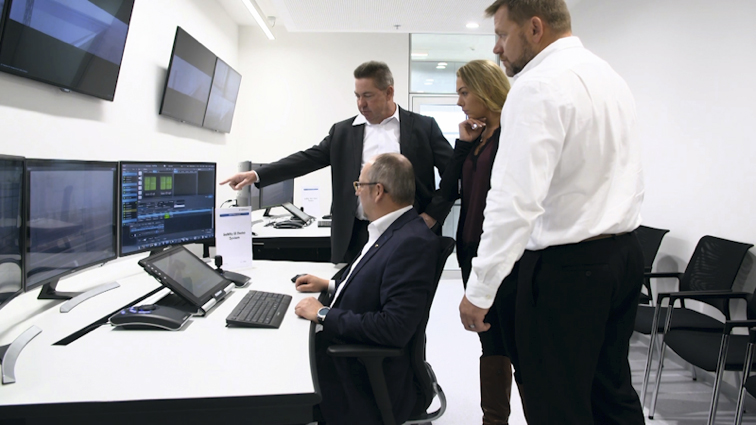
En este artículo, Dallmeier addresses the problems and challenges faced by public officials when selecting the most suitable technology to implement a video surveillance solution in the city.
The implementation of modern video technology in public spaces is gaining more and more supporters. However, in many cases it is still the first project of this type for public officials, and it is often a complex task. It is necessary to coordinate numerous elements and quickly acquire specialized knowledge.
This includes decision-making, approval procedures, public discourse, planning, the identification of synergies and, finally, but no less important, the selection of the appropriate technology for a city surveillance project. This article aims to provide useful information about this last aspect.
No local politician would want a situation like the one, For example, occurred in Cologne on New Year's Eve of 2015. After terrible riots involving several hundred people, more than were submitted 1.200 charges for, entre otras cosas, disturbance of the public order, violence and sexual assault.
The fact that there was only 46 judicial cases and only 33 convictions were due, among other reasons, that the image quality of the recordings from the outdated video system did not allow any evidence to be provided. Either the authors could not be identified due to lack of resolution, even when the course of the criminal event was clearly recognizable; or the possible perpetrators were easily recognizable, but the small image sections from many individual cameras often did not allow reconstructing events in broader optical contexts, so it was not possible to prove involvement in the crime without a doubt.
Image quality, overview, cost
From these and other experiences acquired over many years of video surveillance in public spaces, three key requirements can be deduced: The first is the coverage of large areas with a minimum image quality that is as uniform as possible throughout the object space.
The second point is the recognition of contexts: It must have the ability to capture as much of the monitored area as possible in a single image or, In other words, The number of cameras used must be as low as possible.
Finally, The third point is, of course, The cost: The two main criteria - image quality and recognition of large contexts- They must be feasible at reasonable overall costs.
What does minimum resolution mean and its relevance
But how is image quality actually defined for monitoring large areas? The decisive factor for quality is the required resolution.
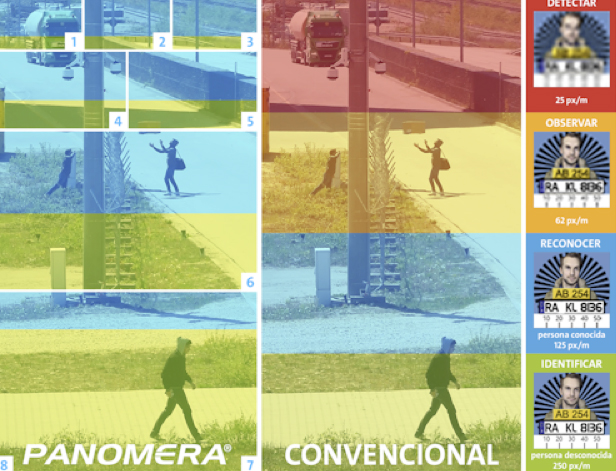
It is what is called resolution density or pixel density, Which is defined in the DIN EN standard 62676-4. La unidad píxeles por metro indica cuántos píxeles están disponibles para representar un metro de realidad.
En el ámbito de la vigilancia urbana, pero también, For example, en instalaciones deportivas, se suele requerir una densidad de resolución de 250 px/m (Identificar según la norma DIN EN 62676-4) o superior para que las imágenes puedan utilizarse de forma fiable en los tribunales. Dicho de otra manera, este es el valor con el que un juez puede decir con un alto grado de probabilidad que la persona sentada frente a él y la persona en la imagen de vídeo son la misma o no. Esto debe ser posible incluso en condiciones de baja iluminación. Dado que este valor debe aplicarse de forma generalizada y no debe caer por debajo de un valor mínimo determinado, it is also called minimum resolution density.
How many cameras cover how many m2?
Once this resolution density is determined for the entire area to be monitored, camera requirements can be inferred through prior planning in collaboration with the manufacturer.
Good planning simulates the entire environment as accurately as possible like a digital twin and allows decision-makers to see and evaluate the exact coverage of pixel density and camera views for all areas. This allows planning that ensures both compliance with the purpose of surveillance - as required, For example, the EU GDPR- like efficient operation, así como la máxima rentabilidad.
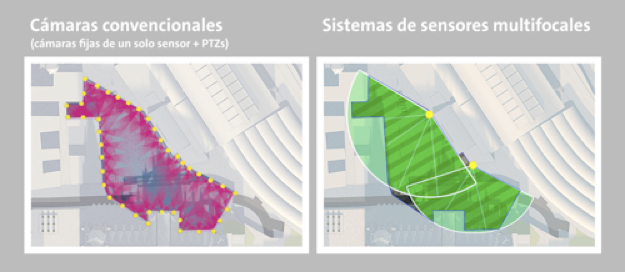
Especialmente adecuados para cumplir estos requisitos, son los llamados sistemas de cámara de sensores multifocal que combinan las imágenes de hasta siete sensores de detalle y un sensor de vista general en una unidad óptica.
Las imágenes individuales se combinan mediante software para formar una imagen general, lo que permite representar contextos muy amplios. Este enfoque combina tres ventajas distintas. La primera un número total de cámaras mucho menor ayuda a reducir el coste total de propiedad ya que se necesita considerablemente menos infraestructura y menos operadores pueden cubrir la misma área.
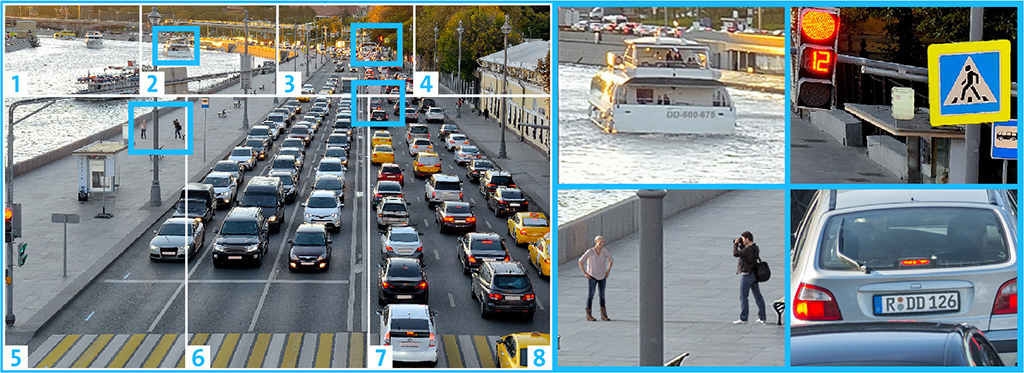
La segunda ventaja es una mejor vista general. Como la imagen es una combinación de hasta ocho imágenes individuales, operators can see the entire scene in a much broader optical context.
And very importantly, the image is always available in high resolution, both live and on recording. Live operators and forensic analysts can zoom indefinitely into this overall image and see any detail in high resolution.
City surveillance and AI
The possibilities – but also the limitations- the benefits of video analysis in urban surveillance are multiple and, therefore, are not the subject of this article. Nevertheless, there is a principle worth keeping in mind for every decision-maker: analysis technology is evolving rapidly and it is advisable to stay informed and observe developments from different analysis specialists.
When selecting camera systems, attention should be paid to image quality being as high and consistent as possible throughout the entire object space. Al fin y al cabo, the quality of analysis results can only be as good as the quality of the input data: input quality, output quality. With the appropriate technology, will also be well equipped for any future analysis application.
How much does one of those cameras cost?
Unfortunately, manufacturers or installers still very often face the question of per-camera costs in consulting discussions or tenders.
Decision-makers should consider modern video surveillance systems as complete solutions, formadas por varios componentes como cámaras, software, sistemas de grabación, servicios y gastos operativos. Dada la naturaleza de la tecnología de vídeo, existen diferencias significativas entre las tecnologías disponibles en cuanto a la eficiencia de funcionamiento, los costes de infraestructura o incluso el esfuerzo necesario para la instalación y despliegue.
Un vistazo más de cerca
Siempre es aconsejable examinar detenidamente los costes totales (total cost of ownership), que tienen en cuenta todos los aspectos de coste de una solución, desde la planificación inicial hasta el funcionamiento en curso. Los responsables de la toma de decisiones deben prestar especial atención a que todos los lotes implicados en un proyecto se consideren conjuntamente.
En muchas licitaciones, the lots for the video system and the lots for the necessary construction and infrastructure measurements are put out to tender separately. Under certain circumstances, this can lead to a significant distortion of total costs, For example, if the cameras are cheaper to acquire, but the infrastructure and installation costs required for them are significantly higher than in a comparative offer.
This occurs frequently when it comes to mounting points such as masts, cabling, excavations or other construction activities. In the end, the principle of the most economical offer and not the cheapest also applies to public tenders.
If all of this is taken into account, The first urban surveillance project will also benefit municipal and police officials, And it will result in greater safety for citizens with maximum cost-effectiveness.
Cost factors in city surveillance
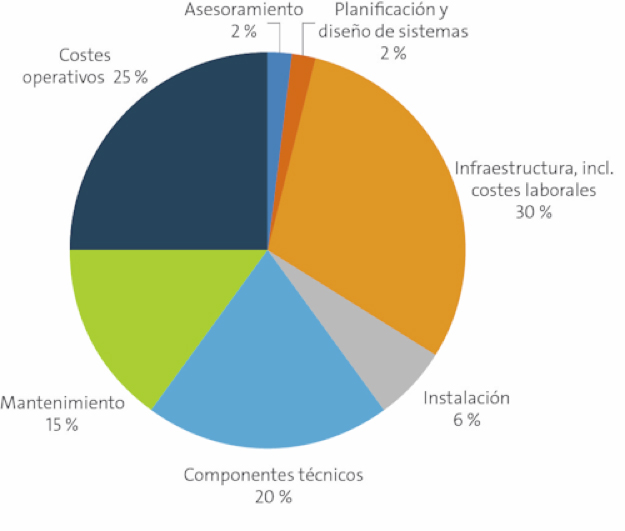
When calculating the total cost of a video technology solution, Many more factors are involved than just the cost of the technical video components: cameras, Recording and software.
Decision-makers would do well to calculate accurately and take into account as many cost factors as possible:
- The advice: How long does it take? Free or already subject to cost?
- The exact image quality requirements: What is the minimum required resolution density and for which areas?? 125 px/m?? 250 px/m??
- The number of cameras: How many cameras and of what type are needed for how many square meters of surface??
- Planning: How much time does planning require?? Which digital systems will be used?? This has a direct impact on implementation speed and also on flexibility.
- Infrastructure costs, Including labor: Are posts required?, Civil engineering, cabling, Network technology?
- The installation cost: here, naturalmente, The total number of cameras needed plays a key role.
- Mounting systems: Are there systems that particularly increase or decrease installation costs??
- Configuration documents: To what extent can the planning data be used directly during on-site installation? Some manufacturers can generate installation documents directly from the planning.
- The costs of the technical components themselves: How much do the cameras cost, Recording systems or software components?
- The costs of ongoing maintenance: What about warranties or support contracts “All-inclusive”?
- Operating costs: What are the labor costs of the operators? How many operators are needed for which solution?
- The cost of 'unproductivity': How user-friendly are the solutions for the operator? How many camera images does each operator have to monitor (normally a maximum of is reasonable 6-8 images per operator)? On the contrary: How many person-hours does the respective solution require for active video observation?
Reflections on privacy
In many urban surveillance projects, again and again, data protection commissioners are perceived as opponents and are kept out of the decision-making process during (too much) time for fear of possible resistance. However, the opposite often happens: the earlier data protection officers are involved - ideally already in the planning phase- the reaction is usually more positive and the supposed opponent often becomes a supporter.
Often, The categorical rejection is simply due to uncertainty and lack of knowledge. If the interests are taken seriously and those involved are informed at an early stage, For example, involving one or several manufacturers, understanding and transparency can be increased. A live demonstration of a test installation of the future system - for example, in the town hall, at a citizens' meeting or an informational event- It is usually very helpful.
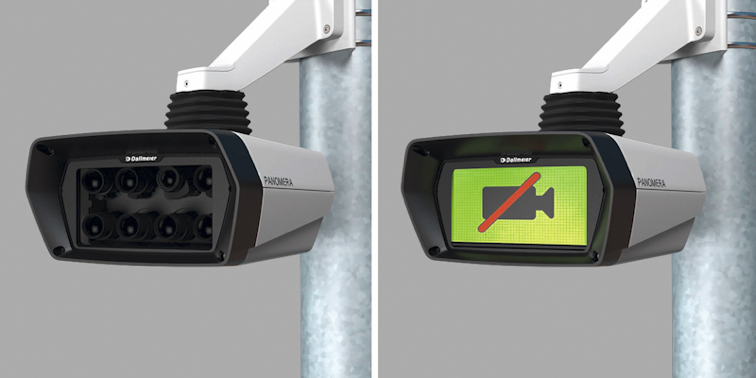
In some countries, like Germany, Video devices in public places must be visibly turned off for participants in legal gatherings. This can be done in a traditional and elaborate way - with very high costs- using lifting platforms and covering them, For example, with cloth bags. But there are also remotely controllable solutions that allow the incident management officer to visibly disable the recording with just a few mouse clicks. Y, above all, the systems can be reactivated just as quickly if the situation changes.
¿Te gustó este artículo?
Subscribe to our NEWSLETTER and you won't miss anything.