


Hanwha Vision expands the functions of its multi-directional cameras with AI
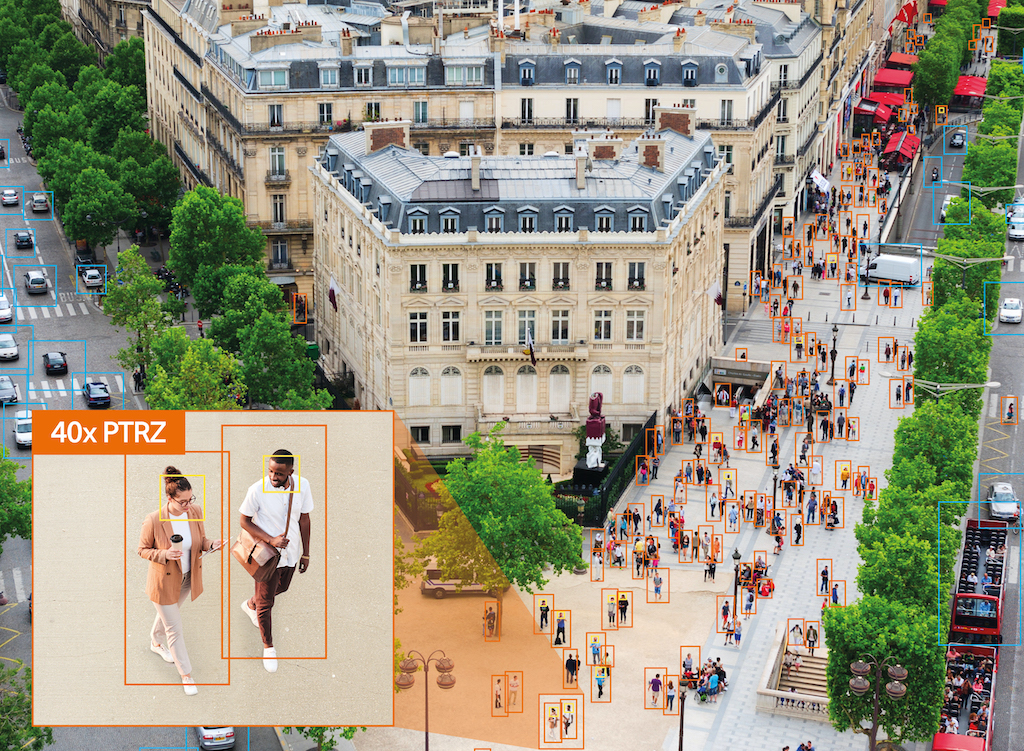
La gama de cámaras con inteligencia artificial de Hanwha Vision suma ahora nuevos modelos multidireccionales de 4 y 5 canales, que incluyen, among other functions, detección y clasificación de objetos con esta tecnología.
Las nuevas cámaras multidireccionales de 4 y 5 canales of Hanwha Vision disponen ahora de un motor de inteligencia artificial, lo que permite a los operadores utilizar las analíticas avanzadas de vídeo en 360°.
Estas soluciones clasifican y detectan rápidamente personas, faces, vehicles (incluidos los tipos) y matrículas; incluyen detección de merodeo y cruce de líneas mediante IA; control Auto Prefer Shutter; tecnología de compresión inteligente WiseStreamⅢ y reducción de ruido WiseNRⅡ.
Los modelos de cámara PNM-C34404RQPZ, PNM-C16083RQZ y PNM-C32083RQZ de Hanwha Vision se benefician de la tecnología de inteligencia artificial, also minimizing the occurrence of false alarms.
Video analysis with AI and deep learning (deep learning) ignores video noise, the movement of tree leaves, and of animals, ultimately, everything that can create false alarms when using conventional motion detection sensors that do not have this technology.
The object classification also facilitates more efficient forensic searches, which means that security administrators can quickly find images of relevant events, thus optimizing the investigation.
Las virtual areas can be configured with AI-based object detection, so that if a person is identified loitering in a specific area, se envía una alerta al operador para que tome las medidas que correspondan.
La tecnología de IA ayuda a mejorar la calidad de las secuencias de vídeo para los operadores. La función BestShot elige automáticamente las mejores imágenes de un objeto o evento para enviarlas a un servidor, minimizando los requisitos de almacenamiento y ancho de banda.
La tecnología de compresión con IA WiseStreamIII de Hanwha Vision aplica tasas de compresión bajas a objetos y personas detectados en las imágenes, and one compresión alta al campo de visión restante, lo que mejora la eficacia del ancho de banda sin comprometer la calidad de las secuencias de vídeo que observan los operadores.
Solutions like WiseNR II noise reduction use AI to reduce blur in noisy and low-light environments; a solution that is complemented by Prefer Shutter, which also uses this technology to automatically adjust the shutter speed and further reduce motion blur.
More efficiency and lower cost
Multidirectional cameras require much less cabling and infrastructure, so that up to five separate cameras provide coverage for large and complex scenes. On the other hand, The AI integrated into the device requires less server room space, since the analysis is performed on the device itself and only metadata is transmitted.
Once the camera is installed, the PTRZ remote adjustment function of model PNM-C34404RQPZ, allows users to adjust the settings, the lens position and viewing angle. Operators no longer have to be physically present at the device installation site to make each adjustment, which improves operational efficiency.
Another advantage of this camera is that it provides clear images in nighttime and low-light conditions, con four independent IR zones and another long-range one dedicated to the PTZ camera. Operators can manually adjust the IR intensity of each zone, avoiding possible reflection problems from nearby objects.
The multidirectional cameras of 4 y 5 channels have a semi-modular design ,compact and sleek, for easy installation and maintenance, as well as cybersecurity features of the highest level to offer operators additional safety measures.
¿Te gustó este artículo?
Subscribe to our NEWSLETTER and you won't miss anything.