


Instalan un agente de aduanas virtual en la frontera entre EE. UU. y México
El Departamento de Aduanas y Patrulla Fronteriza de la Seguridad Nacional (CBP) from the USA. ha instalado en la ciudad de Nogales un agente de control virtual que habla y entiende español e inglés, con objeto de testar su capacidad para agilizar las solicitudes de entrada en el país en la frontera con México.
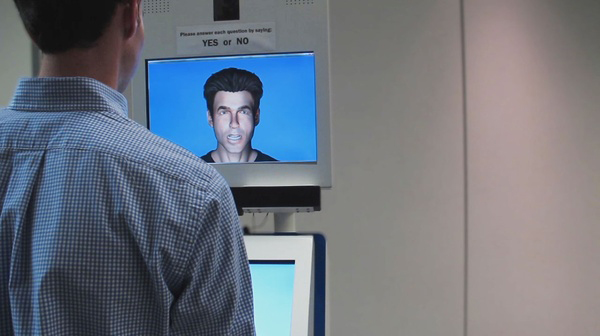
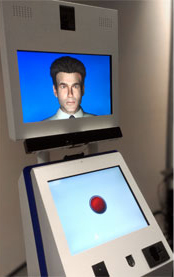
Los viajeros que cruzan la frontera mexicana en la ciudad fronteriza de Nogales -entre el estado mexicano de Sonora y el estado de Arizona (EU)- se van a encontrar a partir de ahora con un nuevo oficial de Aduanas y Protección Fronteriza bilingüe con una espesa mata de pelo negro y una corbata gris a rayas. Este nuevo agente no tiene nombre ni puede unirse a sus compañeros para tomar un café o almorzar, pero su presencia es probable que sea bienvenida tanto por ellos como por los viajeros que pasan regularmente por este puesto fronterizo del sur de Arizona en su camino hacia o desde México. Eso se debe a que el nuevo recluta es un avatar, un oficial de la patrulla fronteriza virtual en forma de kiosco desarrollado por los investigadores de la Universidad de Arizona para facilitar los cruces fronterizos.
El CBP ha instalado este kiosco de la Universidad de Arizona para ayudar a inscribir a los viajeros que solicitan su entrada en el país en la frontera con México. Todos los viajeros deben someterse voluntariamente a una verificación de antecedentes penales, aduanas, inmigración, agricultura y bases de datos de terroristas. El proceso también incluye controles biométricos de huellas dactilares y una entrevista con un oficial del CBP.
En Nogales, oficiales humanos del CBP vigilan las entrevistas piloto realizadas por el avatar, que les proporciona información automatizada enviada de forma inalámbrica a un iPad que estos agentes pueden utilizar para llevar a cabo entrevistas de seguimiento. Las respuestas de los interrogatorios que el avatar marca como cuestionables o dignas de seguimiento -que utiliza el reconocimiento del habla y el software de detección de anomalías de la voz-, están codificadas con colores verde, yellow or red to highlight the potential seriousness of doubtful answers. Every traveler who requests entry into the U.S.. in Nogales ends up speaking with an officer after their interview with the avatar. One of CBP's objectives is the implementation of various kiosks that can handle preliminary interviews which allow saving time when conducting follow-up face-to-face interviews.
 Voice analysis
“The kiosk is not designed to indicate that an interviewee is lying or to diagnose that person's intent”, Aaron Elkins has explained, a researcher in the Information Management Systems department at the University of Arizona who helped develop the kiosk. Instead, The kiosk analyzes the voice of an interviewee to detect anomalies that might prompt a border agent to probe a specific answer further.
The detection of anomalies is based on vocal features - changes in factors such as speed, the volume, pitch, and intonation -, which could be related to different emotional,, excitatory, and cognitive states. A vocal inflection may indicate uncertainty, or a pause could imply that an interviewee may have given a deceptive answer, Elkins indicates. The kiosk's voice recognition software monitors the content of the interviewee's responses and can flag a response indicating when, For example, a person acknowledges having a criminal record. The new Nogales avatar speaks and understands English and Spanish.
Elkins and his colleagues have spent the past few years developing software to analyze vocal and written responses to questions and to enable the avatar to more accurately detect when the interviewee is speaking and to ask interviewees to repeat an answer if it does not understand it. The researchers found that an avatar makes a significant difference in the way interviewees respond to questions. In pre-avatar laboratory tests “it was as if they were talking to Moviefone”. When they added an avatar, people treated it almost like a person, sometimes even referring to it as “sir”.
For now, At the kiosk, the same avatar is used regardless of whether it speaks Spanish or English, although the voice is different depending on the language. “We are still investigating the effects of changes in how it looks right now and the cultural implications, so we are reluctant to make major changes”, points out Elkins.
Researchers hope that this Nogales pilot test will conduct more than 1.000 interviews. Once the virtual agent's performance is analyzed, Elkins would like to add a feature that allows interviewees to scan their passports and other documents on the device. Another option could be to equip the booth with other sensors—such as video analyzers, rastreadores de los ojos y cámaras térmicas o de infrarrojos- que podrían ofrecer medios adicionales para el análisis de los entrevistados.
¿Te gustó este artículo?
Subscribe to our NEWSLETTER and you won't miss anything.